
Revised 3-25-12
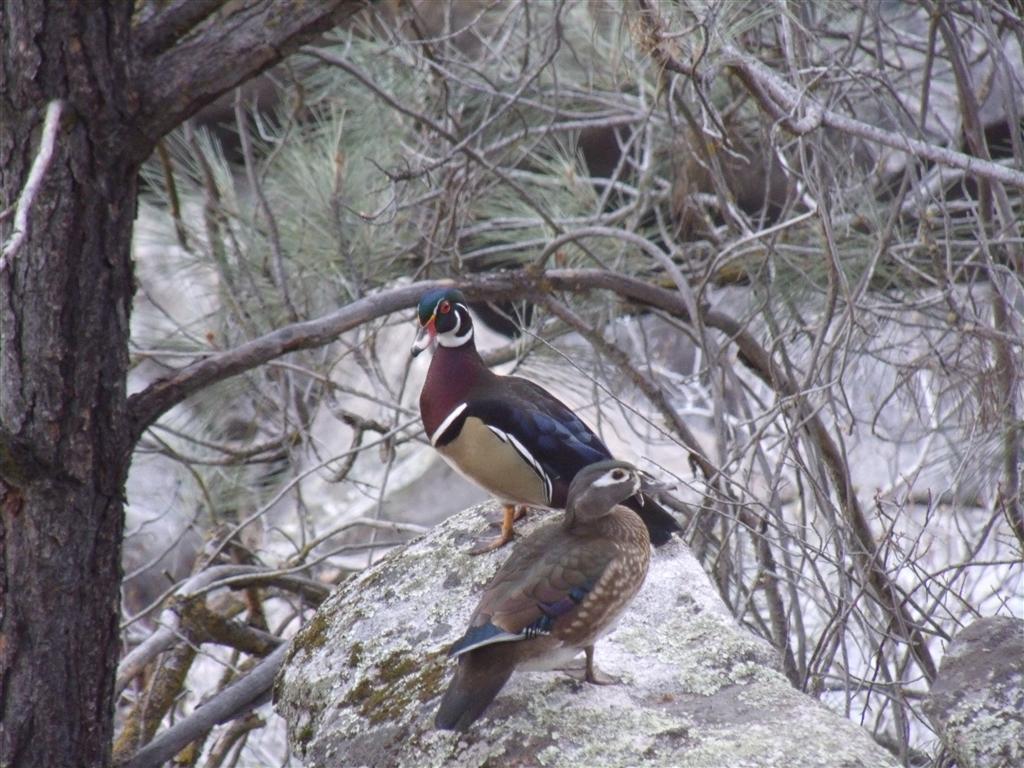
Wood Ducks, a first for Park Sierra!
Photo taken by Gloria Taylor 3-6-12
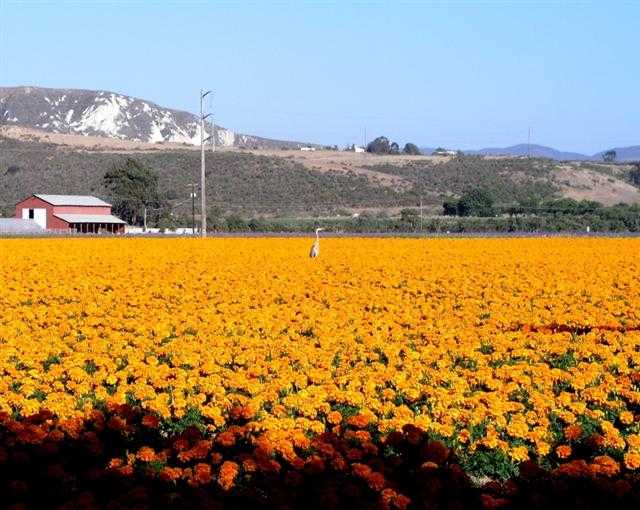
This photo is not of Coarsegold!
Humphrey took this shot near Lompoc.
Check out the bird in the middle of the marigolds.
You could say this Great Blue Heron is out standing in its
field.
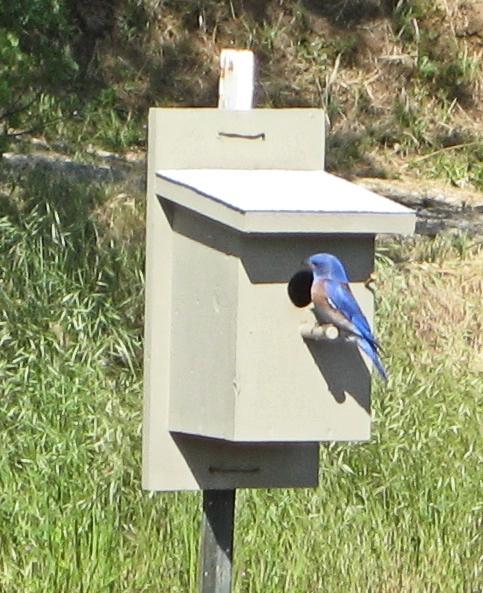
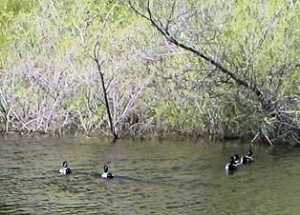
Western Bluebird at his nest box at the
edge of Oak Creek's pond; Mallards in the pond at right
.JPG)
Great Horned Owl
This bird had injuries severe enough that it could not fly, and took
refuge on a neighbor's porch.
The owl family's three young had just fledged, and all the other
owls gathered with this one for a day or two.
Eventually, this
owl made its way to the edge of Oak Creek, but died before help
could be found.
The reason I think it's a male is because I heard a female calling
after this bird's death.
About a week or two later, I heard male-female duetting, so
apparently the female found a new mate.
Photo on the right is of Mallards on Oak
Creek's pond.
The photos below show a pair of Canada
Geese with one gosling.
Adults aren't uncommon, but park members say this is the first baby
they've seen successfully raised at Oak Creek's pond.
.jpg)
.jpg)
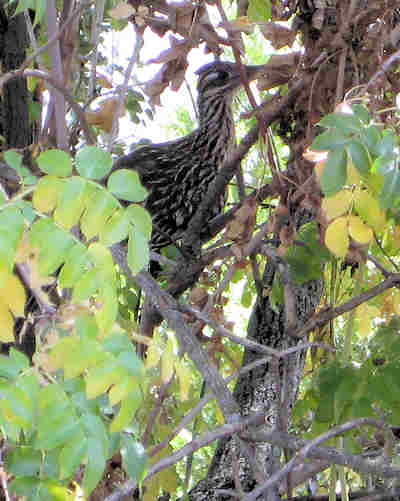
For nearly a week in July 2009, this Greater
Roadrunner came by every day to Oak Creek.
|
Click on the
Bird List
to see my Coarsegold list.
This central California habitat is Sierra foothills
oak-pine woodland,
elevation between
1,200 and 2,200 feet. Spring and fall bring
some migrants,
including hummingbirds
and warblers. Seasonal creeks and the pond at
Oak Creek attract a few
water birds.
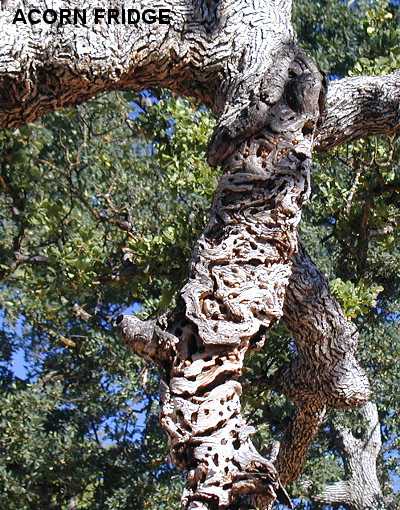
The photo at right shows one of the Acorn
Woodpeckers' larder trees. When they run out
of trees, they stuff their acorns in eaves,
light poles, or slow-moving residents.
|
|
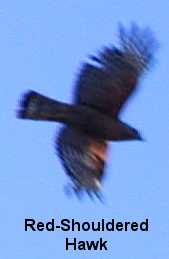
Common species include Canada goose, great horned owl, house finch, red-tailed hawk, red-shouldered hawk,
sharp-shinned hawk,
acorn woodpecker, Nuttall's woodpecker, northern flicker, oak titmouse,
white-breasted nuthatch, bushtit, California quail, mourning dove, spotted
towhee, California towhee, Anna's hummingbird, common raven,
bushtit, lesser goldfinch, and western
bluebird.
Favorite summer residents include Bullock's oriole, black-headed grosbeak,
violet-green swallow, and ash-throated flycatcher. In the
winter, cedar waxwing, white-crowned sparrow, golden-crowned sparrow, dark-eyed
junco, and ruby-crowned kinglet take their places.
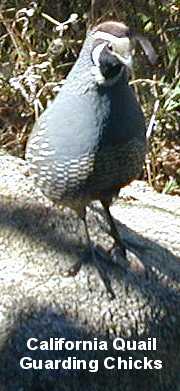
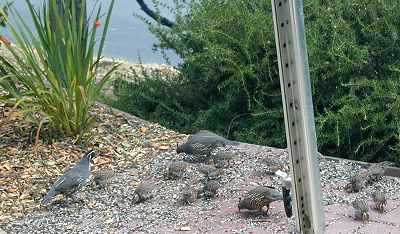
Chicks in the flock below are approximately 2
weeks old.
I've been watching them since they were thimbles-on-legs.
Actually, they are
two
flocks, and although they travel
together,
the babies occasionally show their separation
by congregating next to their mothers.
The initial flock had 18 chicks. It's down to 14 or 15,
which isn't bad for a couple of weeks.
Attrition is very high for quail babies.
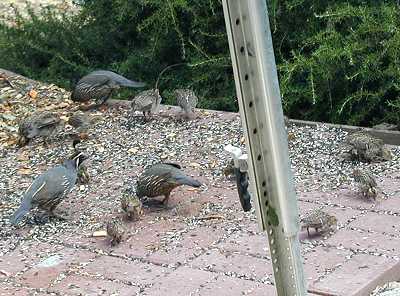
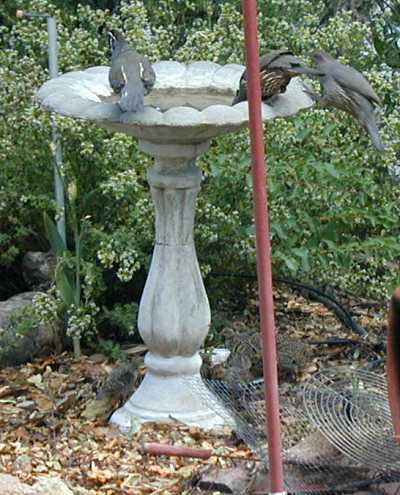
The adults drink from the birdbath, while the
babies drink from a pie tin below.
I have large perching rocks in the shallow tin because
small chicks easily drown in deep water containers.
In some years we get an influx of a particular species; in 1999 it was evening
grosbeaks; other times it might be pine siskins, American robins, or hermit
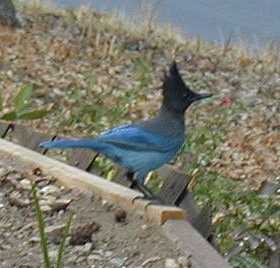
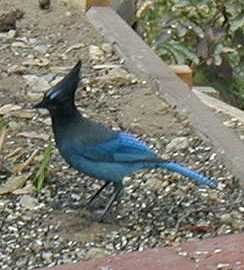
thrushes. The 2003/2004 winter season brought us dozens of
Steller's jays. It's highly unusual to see even
one
at our elevation, and
many of these birds stayed for months!

 HUMMERS
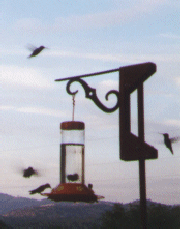
My favorite species. The photo at left shows Anna's hummingbirds beginning to
collect at one of my three feeders for their evening feed.
A few Anna's stay year-round. Black-Chinned are fairly regular except in
winter, and in migration we have Rufous, Costa's, Calliope, and possibly
Allen's. Rufous ("Copper Pennies," one of our
residents calls them) are the most numerous in migration.
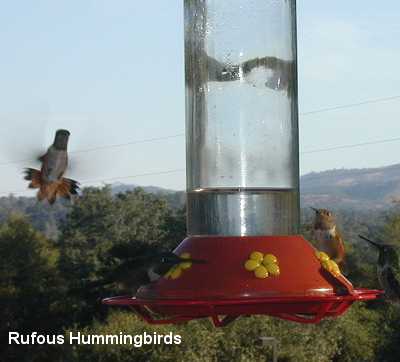
During the height of migration, the hummers
can empty two quart feeders twice a
day. These mighty mites usually fight fiercely for a position at the six-hole
feeders, but sometimes the birds are so numerous that they give up the battle
and simply share. Each feeder may have two birds at each flower hole, sipping
in turn, with dozens more hovering overhead, hoping to oust
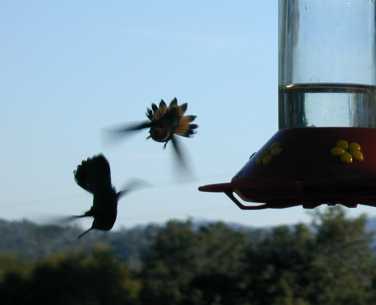
them. In the photos below, take a look at the photo on the
right. The leftmost bird looks upside down to me.
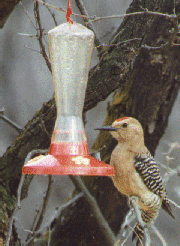
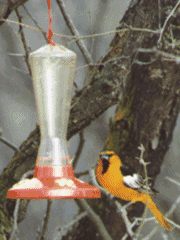 These two photos show birds that
think
they are hummingbirds. The one on the left, the Gila Woodpecker, is an Arizona
specialty. Acorn Woodpeckers peck off the flowers
and bee guards from my
feeders to get at the sugar-water.
These two photos show birds that
think
they are hummingbirds. The one on the left, the Gila Woodpecker, is an Arizona
specialty. Acorn Woodpeckers peck off the flowers
and bee guards from my
feeders to get at the sugar-water.
The beauty on the right is a Bullock's Oriole, photographed in Arizona at the
same location. We have them here, but I haven't been
able to get a photograph yet.
You just never know what you will get when you put out sugar-water!
Click on me to see a Phabulous Phowl
A FEW LINKS
American Birding Association
National Audubon Society
The Nature Conservancy
Cornell Lab of Ornithology
Thayer Birding
— I use
Birder's Diary
for my lists and the latest
Guide to Birds of North America
for songs and
identifications
Patuxent Bird Identification InfoCenter
— Photos, songs, ID tips, maps, life history
Fugleskue Birdwatch
— Excellent links
Joe Morlan's California Birding Pages
— Latest hot birds with photos
Steve Sosensky's Birding Web Sites
— Many links, bird sounds
Greg Lasley's Web Site
—Terrific photos